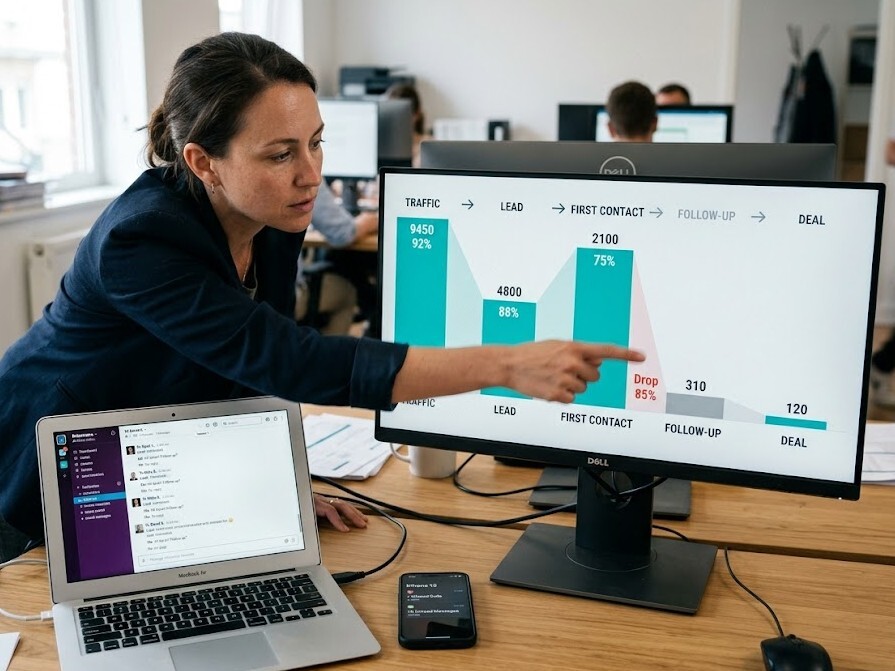
Low conversion rarely starts where people think
When results fall, most businesses blame traffic first. They assume the audience is weak, the ad is not working, or the platform has stopped performing. Sometimes that is true. But in many cases, conversion dies much deeper in the system.
The real loss usually happens after the click, when attention enters a weak structure.
Traffic brings people in. It does not close the gap
A click only means one thing: the message was strong enough to create interest. After that, the business still has to do the harder part. It has to explain the offer, reduce hesitation, build trust, and move the person toward action.
This is where conversion often breaks.
Usually the problem looks like this:
In other words, attention exists, but decision readiness does not.
Most leaks happen in the transition stage
One of the weakest parts of many funnels is the space between interest and action. The person already noticed the offer, maybe even liked it, but still does nothing.
That gap is where conversion quietly dies.
Why? Because businesses often rush too fast. They ask for the lead, the call, or the sale before the person fully understands the problem or trusts the solution. The funnel jumps from attraction to pressure without doing enough warming in the middle.
Weak lead handling destroys good demand
Even when marketing works, poor internal handling can kill the result. A lead comes in, but the response is slow. The manager gives weak answers. Follow-up is inconsistent. CRM stages are messy. No one really knows what should happen next.
At that point, conversion is no longer a traffic issue. It is an operational issue.
Good demand enters the system and dies from poor handling.
Without analytics, businesses fix the wrong stage
This is why many teams keep changing creatives, ads, and targeting while the real problem stays untouched. They can see clicks and leads, but they cannot see where the path actually breaks.
A stronger system should show:
Without that, conversion problems stay hidden behind assumptions.
Conversion dies where clarity, trust, and process are weak
The exact stage may vary, but the pattern is usually the same. Conversion drops where the buyer feels too much friction and not enough certainty.
That friction often comes from:
This is why conversion should never be judged by one page or one campaign alone. It is the result of the full system.
Conclusion
Conversion usually does not die because people are not interested. It dies because the business fails to carry that interest through a clear and structured path.
If traffic is coming in but results stay weak, the issue is often not at the top of the funnel. It is in the middle, where trust should grow, objections should be reduced, and leads should be handled properly. If you want better conversion, stop looking only at the click and start fixing what happens after it.
When results fall, most businesses blame traffic first. They assume the audience is weak, the ad is not working, or the platform has stopped performing. Sometimes that is true. But in many cases, conversion dies much deeper in the system.
The real loss usually happens after the click, when attention enters a weak structure.
Traffic brings people in. It does not close the gap
A click only means one thing: the message was strong enough to create interest. After that, the business still has to do the harder part. It has to explain the offer, reduce hesitation, build trust, and move the person toward action.
This is where conversion often breaks.
Usually the problem looks like this:
- the offer is unclear
- the page does not explain the value fast enough
- the next step feels vague
- proof is weak or missing
- the lead is not handled properly after contact
In other words, attention exists, but decision readiness does not.
Most leaks happen in the transition stage
One of the weakest parts of many funnels is the space between interest and action. The person already noticed the offer, maybe even liked it, but still does nothing.
That gap is where conversion quietly dies.
Why? Because businesses often rush too fast. They ask for the lead, the call, or the sale before the person fully understands the problem or trusts the solution. The funnel jumps from attraction to pressure without doing enough warming in the middle.
Weak lead handling destroys good demand
Even when marketing works, poor internal handling can kill the result. A lead comes in, but the response is slow. The manager gives weak answers. Follow-up is inconsistent. CRM stages are messy. No one really knows what should happen next.
At that point, conversion is no longer a traffic issue. It is an operational issue.
Good demand enters the system and dies from poor handling.
Without analytics, businesses fix the wrong stage
This is why many teams keep changing creatives, ads, and targeting while the real problem stays untouched. They can see clicks and leads, but they cannot see where the path actually breaks.
A stronger system should show:
- where users drop off
- which leads are qualified
- how fast follow-up happens
- what source brings revenue, not just forms
- which stage creates the biggest loss
Without that, conversion problems stay hidden behind assumptions.
Conversion dies where clarity, trust, and process are weak
The exact stage may vary, but the pattern is usually the same. Conversion drops where the buyer feels too much friction and not enough certainty.
That friction often comes from:
- unclear positioning
- weak website structure
- no warming logic
- poor qualification
- inconsistent follow-up
- disconnected CRM and analytics
This is why conversion should never be judged by one page or one campaign alone. It is the result of the full system.
Conclusion
Conversion usually does not die because people are not interested. It dies because the business fails to carry that interest through a clear and structured path.
If traffic is coming in but results stay weak, the issue is often not at the top of the funnel. It is in the middle, where trust should grow, objections should be reduced, and leads should be handled properly. If you want better conversion, stop looking only at the click and start fixing what happens after it.