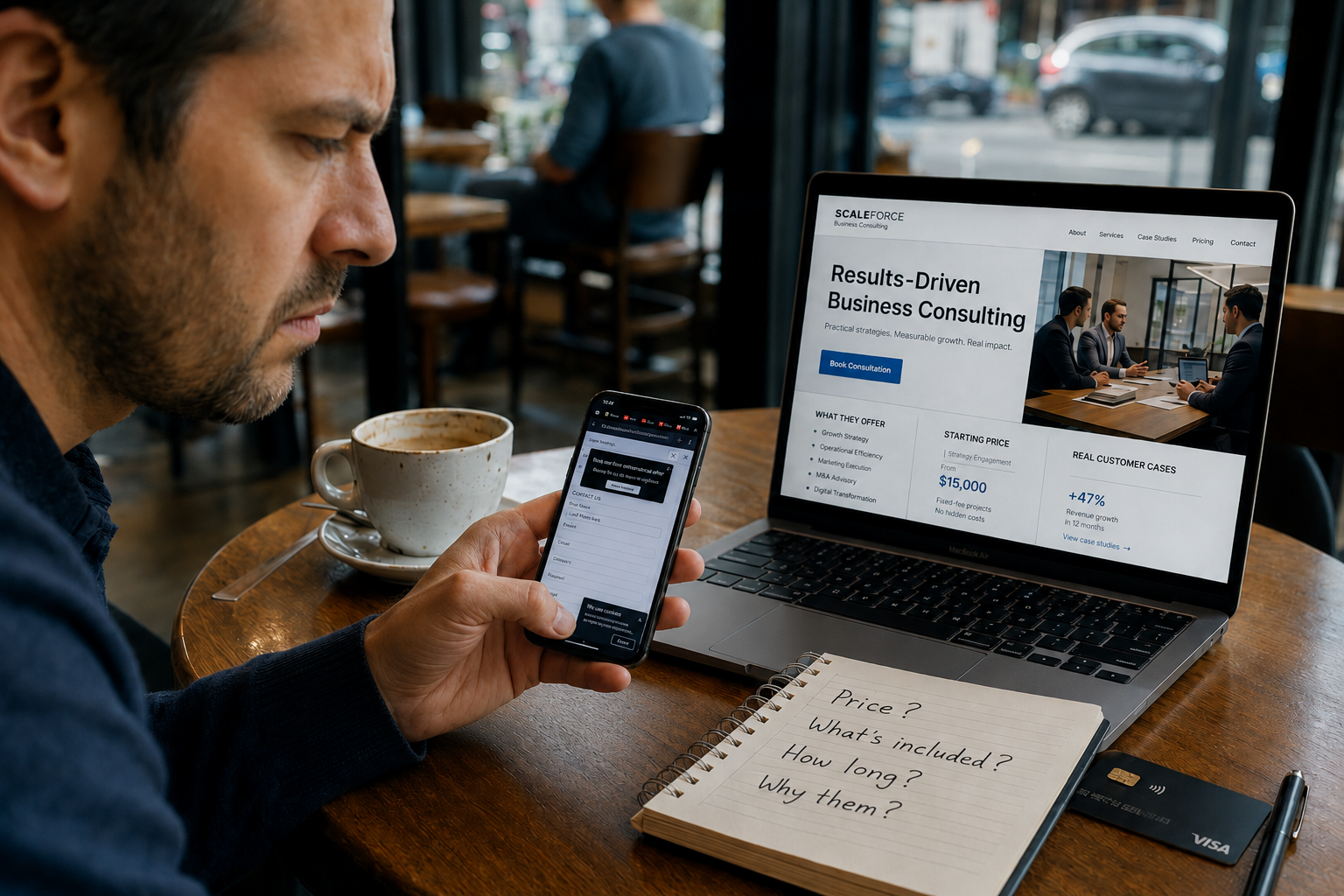
How to Tell If Your Website Is Reducing Sales Before Contact
Your sales manager may never get the chance to fix the problem
Businesses often analyse sales only after a lead reaches the CRM. They review scripts, manager performance, objections, follow-up, and close rates.
But a large part of the decision happens earlier.
Before a prospect speaks to anyone, the website has already influenced whether the company feels relevant, credible, expensive, confusing, or worth contacting.
If the site weakens that decision, sales loses clients it never even sees.
The first sign is relevant traffic without enough inquiries
A website can receive visitors from advertising, search, social media, or referrals and still produce very few qualified requests.
The usual reaction is to blame traffic.
But if the audience is relevant and visitors are reaching the right pages, the problem may be conversion rather than acquisition.
A prospect should quickly understand:
If those answers require several minutes of searching, the website is creating friction before the sales process begins.
The first screen does not confirm the visitor made the right click
The top of the page has one critical job: continue the expectation created before the visit.
If an advertisement promises one result and the website opens with a generic corporate headline, momentum disappears immediately.
Weak first screens often contain:
The design can look expensive while the commercial message remains weak.
A visitor should not need to interpret what the company actually does.
The website talks about the company instead of the customer
“We are a professional team.”
“We use innovative technologies.”
“We provide high-quality solutions.”
None of these statements explains why the prospect should act.
Customers are evaluating their own situation. They want to understand what changes for them.
Strong website communication connects the offer to:
If the website focuses primarily on the company, sales has to rebuild the value from zero during the first conversation.
Visitors cannot see enough proof
Interest creates attention. Proof creates confidence.
Before contacting sales, prospects often look for evidence that the company can actually deliver what it promises.
That evidence may include:
Generic statements such as “trusted by many clients” rarely reduce risk.
If the website makes a strong promise but provides weak evidence, the visitor becomes interested without becoming confident enough to act.
The site creates price resistance before price is even discussed
Price objections do not always begin during the sales call.
They can start on the website.
If the page fails to communicate value, the prospect has no framework for understanding the investment. When they finally see a price or speak to a manager, the number feels expensive because the expected result still feels vague.
This is why improving sales conversion is not always about teaching managers to handle objections better.
Sometimes the website creates the objection before the manager enters the conversation.
The next step feels too heavy
A visitor may understand the service and still leave because the requested action requires too much commitment.
Common examples include:
The prospect starts calculating effort and risk.
A stronger call to action makes the next step predictable:
Reducing uncertainty often improves conversion without changing traffic volume.
The website attracts inquiries from the wrong clients
A high number of leads does not automatically mean the website works well.
If managers constantly receive inquiries from people who do not fit the offer, the site may be communicating too broadly.
Typical symptoms include:
A strong website should not only persuade. It should also filter.
Clear positioning helps unsuitable visitors understand that the offer is not for them while increasing confidence among the right prospects.
The website does not answer objections before the call
Sales teams often hear the same questions repeatedly:
“How does it work?”
“How long does it take?”
“Why is your approach different?”
“What happens after we start?”
“Have you worked with companies like ours?”
If these questions appear in almost every conversation, part of the website is probably missing.
The site should not replace the manager, but it should prepare the prospect.
A better-prepared lead enters the conversation with fewer basic doubts and more attention available for the actual decision.
The website and sales process tell different stories
Another major conversion problem appears when marketing, website, and sales are not aligned.
The advertisement promises speed.
The website focuses on expertise.
The sales manager talks about customization.
The proposal focuses on deliverables.
Each message may be reasonable individually, but together they create inconsistency.
A strong funnel maintains the same logic from first impression to payment. The promise may become more detailed, but it should not fundamentally change at every stage.
Consistency builds confidence.
How to diagnose whether the website is hurting sales
Do not judge the site only by design or total number of leads.
Look at the full path:
Also review the website from the client’s perspective.
Can a new visitor understand the offer in seconds? Is the value clear? Is there enough proof? Does the next step feel safe and logical?
If the answer is no, the site is adding resistance before your team has a chance to sell.
Conclusion
A website reduces sales before the conversation when it creates more questions than confidence.
Weak positioning, unclear value, missing proof, poor qualification, and unnecessary friction can make potential customers leave without ever entering the CRM.
If your team is buying relevant traffic but sales receives too few qualified inquiries, do not look only at advertising or manager performance. Audit the website as part of the complete funnel and identify what the client sees, understands, and doubts before the first conversation begins.
Your sales manager may never get the chance to fix the problem
Businesses often analyse sales only after a lead reaches the CRM. They review scripts, manager performance, objections, follow-up, and close rates.
But a large part of the decision happens earlier.
Before a prospect speaks to anyone, the website has already influenced whether the company feels relevant, credible, expensive, confusing, or worth contacting.
If the site weakens that decision, sales loses clients it never even sees.
The first sign is relevant traffic without enough inquiries
A website can receive visitors from advertising, search, social media, or referrals and still produce very few qualified requests.
The usual reaction is to blame traffic.
But if the audience is relevant and visitors are reaching the right pages, the problem may be conversion rather than acquisition.
A prospect should quickly understand:
- what you offer
- who it is for
- what problem it solves
- what result they can expect
- why they should trust you
- what they should do next
If those answers require several minutes of searching, the website is creating friction before the sales process begins.
The first screen does not confirm the visitor made the right click
The top of the page has one critical job: continue the expectation created before the visit.
If an advertisement promises one result and the website opens with a generic corporate headline, momentum disappears immediately.
Weak first screens often contain:
- vague positioning
- abstract slogans
- generic claims about quality
- too many different services
- no clear outcome
- multiple competing calls to action
The design can look expensive while the commercial message remains weak.
A visitor should not need to interpret what the company actually does.
The website talks about the company instead of the customer
“We are a professional team.”
“We use innovative technologies.”
“We provide high-quality solutions.”
None of these statements explains why the prospect should act.
Customers are evaluating their own situation. They want to understand what changes for them.
Strong website communication connects the offer to:
- the problem being removed
- the result being created
- the time or money being saved
- the risk being reduced
- the opportunity being gained
If the website focuses primarily on the company, sales has to rebuild the value from zero during the first conversation.
Visitors cannot see enough proof
Interest creates attention. Proof creates confidence.
Before contacting sales, prospects often look for evidence that the company can actually deliver what it promises.
That evidence may include:
- relevant case studies
- specific results
- client examples
- testimonials
- clear process descriptions
- industry experience
- real examples of completed work
Generic statements such as “trusted by many clients” rarely reduce risk.
If the website makes a strong promise but provides weak evidence, the visitor becomes interested without becoming confident enough to act.
The site creates price resistance before price is even discussed
Price objections do not always begin during the sales call.
They can start on the website.
If the page fails to communicate value, the prospect has no framework for understanding the investment. When they finally see a price or speak to a manager, the number feels expensive because the expected result still feels vague.
This is why improving sales conversion is not always about teaching managers to handle objections better.
Sometimes the website creates the objection before the manager enters the conversation.
The next step feels too heavy
A visitor may understand the service and still leave because the requested action requires too much commitment.
Common examples include:
- long contact forms
- too many mandatory fields
- “Request a quote” without context
- booking a full sales call immediately
- no explanation of what happens after submission
The prospect starts calculating effort and risk.
A stronger call to action makes the next step predictable:
- what they will receive
- how long it will take
- who will contact them
- whether there is any obligation
- what happens after the request
Reducing uncertainty often improves conversion without changing traffic volume.
The website attracts inquiries from the wrong clients
A high number of leads does not automatically mean the website works well.
If managers constantly receive inquiries from people who do not fit the offer, the site may be communicating too broadly.
Typical symptoms include:
- prospects with unrealistic budgets
- requests for services you do not provide
- people who misunderstand the format
- clients expecting a completely different result
- excessive qualification required on every call
A strong website should not only persuade. It should also filter.
Clear positioning helps unsuitable visitors understand that the offer is not for them while increasing confidence among the right prospects.
The website does not answer objections before the call
Sales teams often hear the same questions repeatedly:
“How does it work?”
“How long does it take?”
“Why is your approach different?”
“What happens after we start?”
“Have you worked with companies like ours?”
If these questions appear in almost every conversation, part of the website is probably missing.
The site should not replace the manager, but it should prepare the prospect.
A better-prepared lead enters the conversation with fewer basic doubts and more attention available for the actual decision.
The website and sales process tell different stories
Another major conversion problem appears when marketing, website, and sales are not aligned.
The advertisement promises speed.
The website focuses on expertise.
The sales manager talks about customization.
The proposal focuses on deliverables.
Each message may be reasonable individually, but together they create inconsistency.
A strong funnel maintains the same logic from first impression to payment. The promise may become more detailed, but it should not fundamentally change at every stage.
Consistency builds confidence.
How to diagnose whether the website is hurting sales
Do not judge the site only by design or total number of leads.
Look at the full path:
- traffic source to landing page
- landing page to CTA click
- CTA click to form completion
- request to qualified lead
- qualified lead to sales conversation
- recurring objections during calls
- reasons prospects refuse after visiting the site
Also review the website from the client’s perspective.
Can a new visitor understand the offer in seconds? Is the value clear? Is there enough proof? Does the next step feel safe and logical?
If the answer is no, the site is adding resistance before your team has a chance to sell.
Conclusion
A website reduces sales before the conversation when it creates more questions than confidence.
Weak positioning, unclear value, missing proof, poor qualification, and unnecessary friction can make potential customers leave without ever entering the CRM.
If your team is buying relevant traffic but sales receives too few qualified inquiries, do not look only at advertising or manager performance. Audit the website as part of the complete funnel and identify what the client sees, understands, and doubts before the first conversation begins.